Over the past decade, Saudi Arabia has changed the architecture of its health system at a pace few countries have attempted. Health clusters have been established, purchasing and provision are becoming more distinct, digital infrastructure has expanded, and value-based health care has moved from an international policy idea into the language of the Kingdom’s own health transformation. The Council of Health Insurance has already explored a national approach to patient-reported outcomes, including work linking outcome measurement with value-based contracting.
The scale of that transformation is easy to see. The more difficult question is what comes next.
A modern health system can know, with increasing precision, how many procedures it performs, how much they cost, how long patients stay in hospital and how often complications occur. These measures are essential. But they still describe, for the most part, what the health system did. They do not always tell us what happened to the patient.
A woman may leave hospital after a technically successful knee replacement without infection or readmission. Six months later, however, she may still struggle to walk comfortably or climb the stairs. A man with heart failure may receive treatment that satisfies every clinical guideline while continuing to find ordinary daily activities exhausting. A patient with diabetes may show an improvement in laboratory results without experiencing a corresponding improvement in quality of life.
Those are not marginal questions. They are the outcomes that often matter most to the people receiving care. Yet they are also among the outcomes that traditional administrative and clinical systems are least able to see. A claim can tell us that a service was delivered. An electronic medical record can tell us what a clinician observed. A laboratory can tell us what happened to a biomarker. Some information, however, exists only because the patient tells us.
For Saudi Arabia, this creates an unusual opportunity. The Kingdom does not need to discover the idea of patient-reported outcomes from first principles. Health systems elsewhere have already spent years learning what works, what fails, and why programmes that look promising on paper often struggle once they meet the realities of clinical practice. The task now is to translate that accumulated experience into the Saudi context and, where possible, avoid repeating mistakes other systems made along the way.
The lesson is not to build a survey programme
One of the clearest lessons from international experience is that patient-reported outcomes fail when they are treated primarily as questionnaires.
A hospital may send a survey after treatment, produce a dashboard and report a respectable completion rate. That may be useful for research or reporting, but it is not necessarily value-based care. The more important question is whether the information changes anything.
If a patient recovering from surgery reports increasing pain and declining function, does somebody see it? Does it alter follow-up? Does it trigger a call, an assessment or an earlier intervention? If not, the health system has collected an outcome without incorporating it into care.
This distinction sounds obvious, but it has been one of the most persistent implementation problems internationally. Outcome programmes are often added beside clinical care rather than embedded within it. Data are gathered because measurement itself has become a target. The result is another stream of information competing for the attention of clinicians and managers who already have more dashboards than time.
The programmes that become useful tend to start somewhere else: with a decision.
What information would help a clinician manage this patient differently? What would help a pathway leader understand why one service is outperforming another? What would allow a purchaser to distinguish between a provider that delivers more activity and one that delivers better outcomes?
Only after answering those questions does measurement become meaningful.
That approach is particularly relevant in Saudi Arabia. A national outcomes strategy does not have to begin by asking which questionnaires every organisation should collect. It can begin by asking where better information could improve an important decision and then build measurement around that purpose.
From patient to pathway to system
There are three levels at which that information becomes valuable.
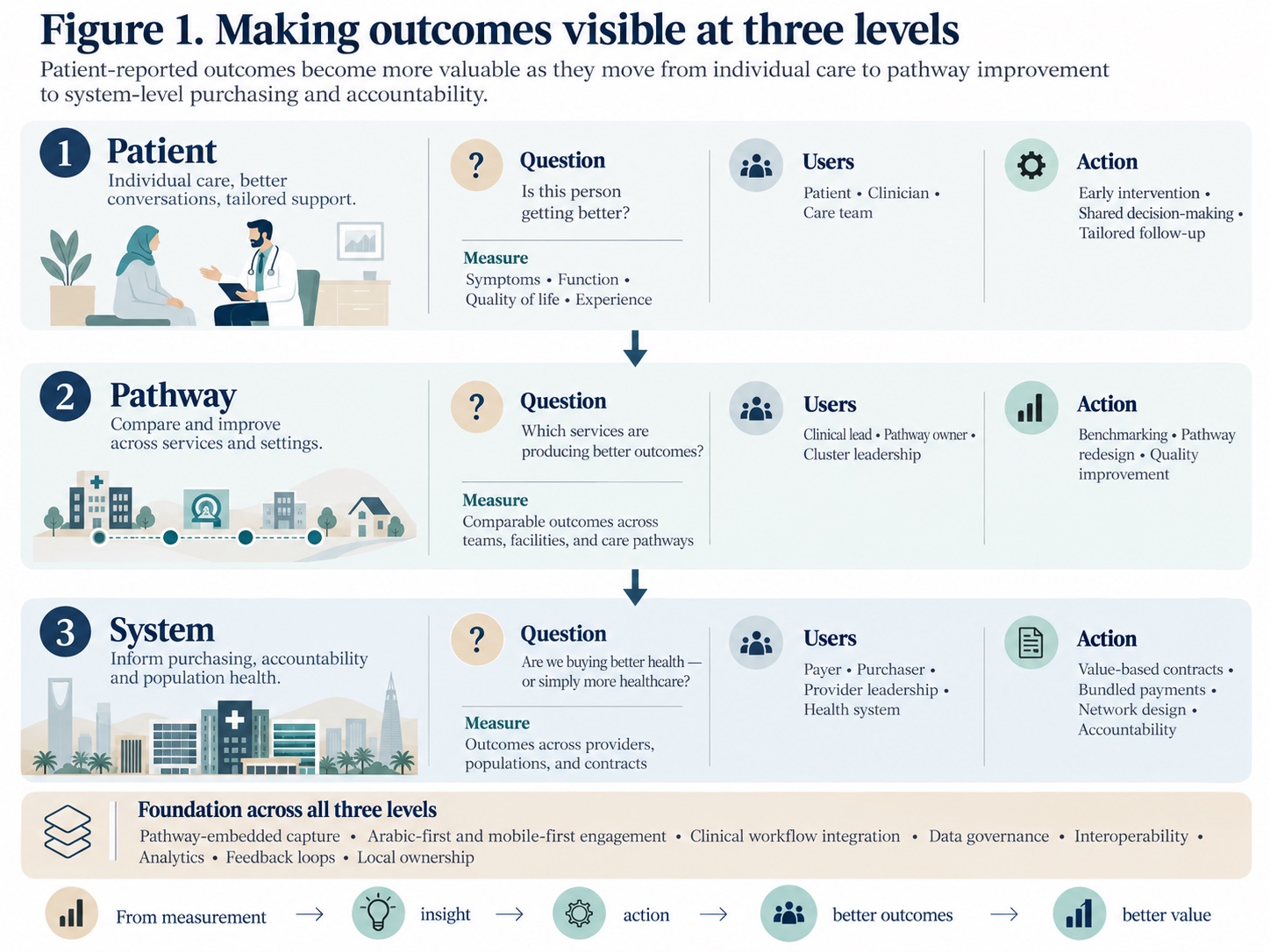
At the first level is the individual patient. Here, patient-reported outcomes can act as an extension of clinical care. A short assessment completed during recovery can show whether pain, function or quality of life is improving as expected. For most patients, the answer may be reassuring. For a smaller number, the information can identify deterioration before the next scheduled appointment.
This requires more than selecting a validated instrument. The collection must fit naturally into the patient journey. In Saudi Arabia, that means thinking carefully about Arabic-first design, mobile use and the channels patients already use in everyday life. It also means resisting the temptation to impose the logic of the measurement system on the patient. If the process is cumbersome, separate from care or difficult to understand, participation will eventually decline.
The second level is the care pathway. Here, outcomes do something that activity data alone cannot: they reveal variation in results.
Two hospitals may treat similar patients using similar guidelines and still produce different outcomes. Without common measures, that variation can remain invisible. Once the same outcomes are measured consistently, leaders can begin to ask why one pathway appears to produce better recovery, function or quality of life than another.
That is where standardisation matters. International frameworks such as ICHOM’s Standard Sets were developed precisely because meaningful comparison requires organisations to measure the same things in the same way. But standards alone are not enough. Local teams still have to determine how information is collected, how it fits the pathway, who responds to it and how improvement follows.
This balance between standardisation and local ownership is important for Saudi health clusters. A cluster does not need identical clinical workflows in every facility. It does, however, need enough consistency in what it measures to understand where better outcomes are being achieved and where variation deserves attention. That turns measurement into a mechanism for learning across the system rather than simply an exercise in performance reporting.
The third level is the system itself. This is where patient-reported outcomes begin to connect directly with value-based health care.
A purchaser cannot meaningfully purchase an outcome it cannot observe. A bundled payment may include the cost of surgery, rehabilitation and follow-up, but if the purchaser cannot see whether patients regain function, an important part of the value equation remains missing. The same issue arises in network design, provider benchmarking and outcome-linked contracting.
As Saudi Arabia’s purchasing arrangements mature, this is likely to become increasingly important. The question is no longer simply whether a provider delivered the required activity at an acceptable cost. It is whether the patient achieved a better result, and whether that result was achieved efficiently.
The three levels therefore should not be thought of as separate programmes. They are different uses of the same information. At the patient level, outcomes can influence care. At the pathway level, they can expose variation and guide improvement. At the system level, they can inform purchasing and accountability.
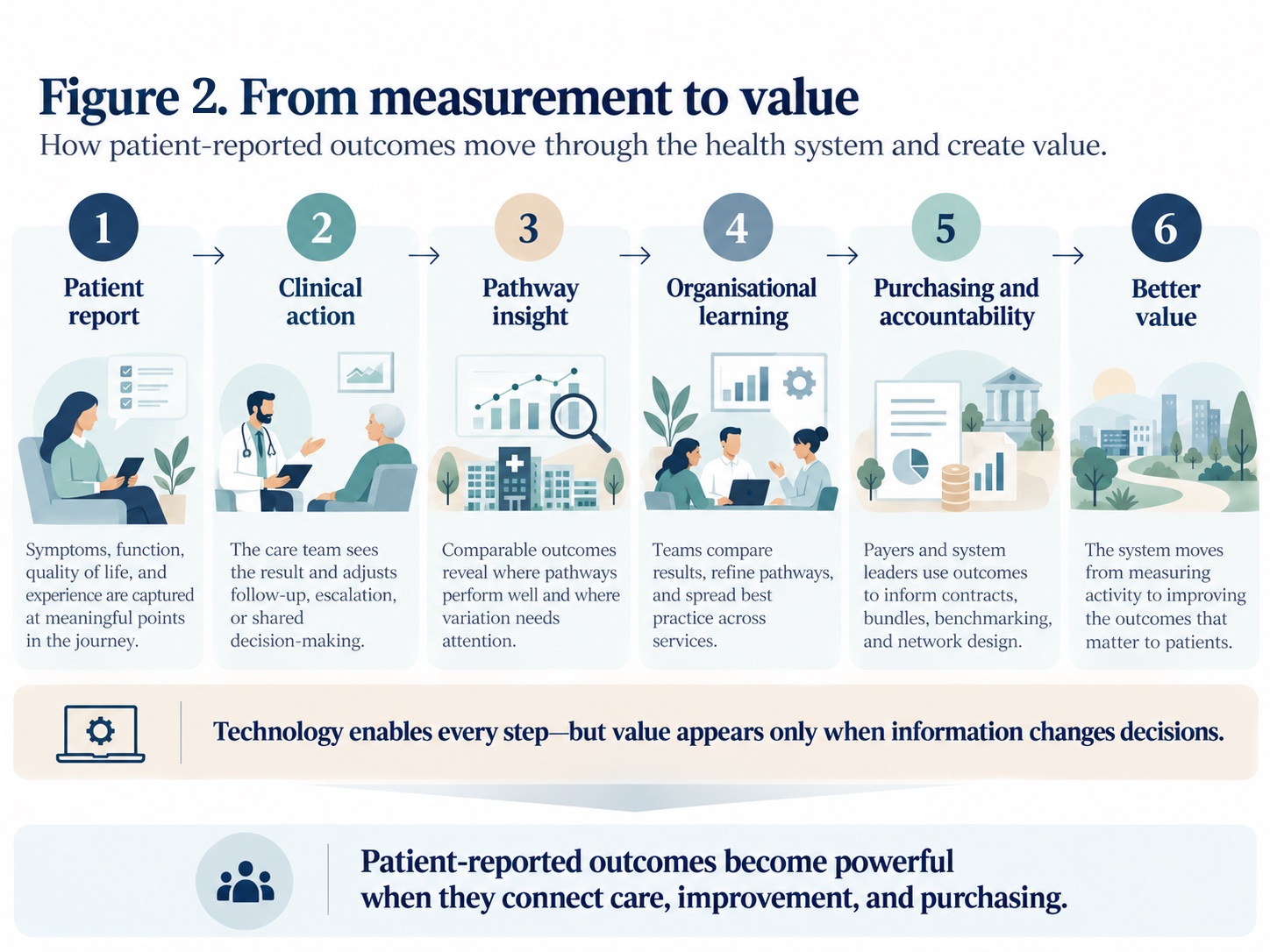
What Saudi Arabia can learn before it scales
The advantage of moving now is that Saudi Arabia can draw on a much larger body of implementation experience than existed a decade ago.
The Clinician has been part of that experience across different health systems, from large-scale implementation in South Australia to work with SingHealth in Singapore and projects in Saudi Arabia. The importance of these examples is not simply their size. It is the practical knowledge accumulated from trying to make outcomes measurement work inside real organisations: how to integrate it with clinical pathways, how to engage patients, how to structure governance, how to standardise without losing local ownership, and how to ensure the data return to the people who can use them. The original Saudi work also included The Clinician alongside PwC and the Council of Health Insurance in the design of a national approach to patient-reported outcome measurement.
Several lessons recur.
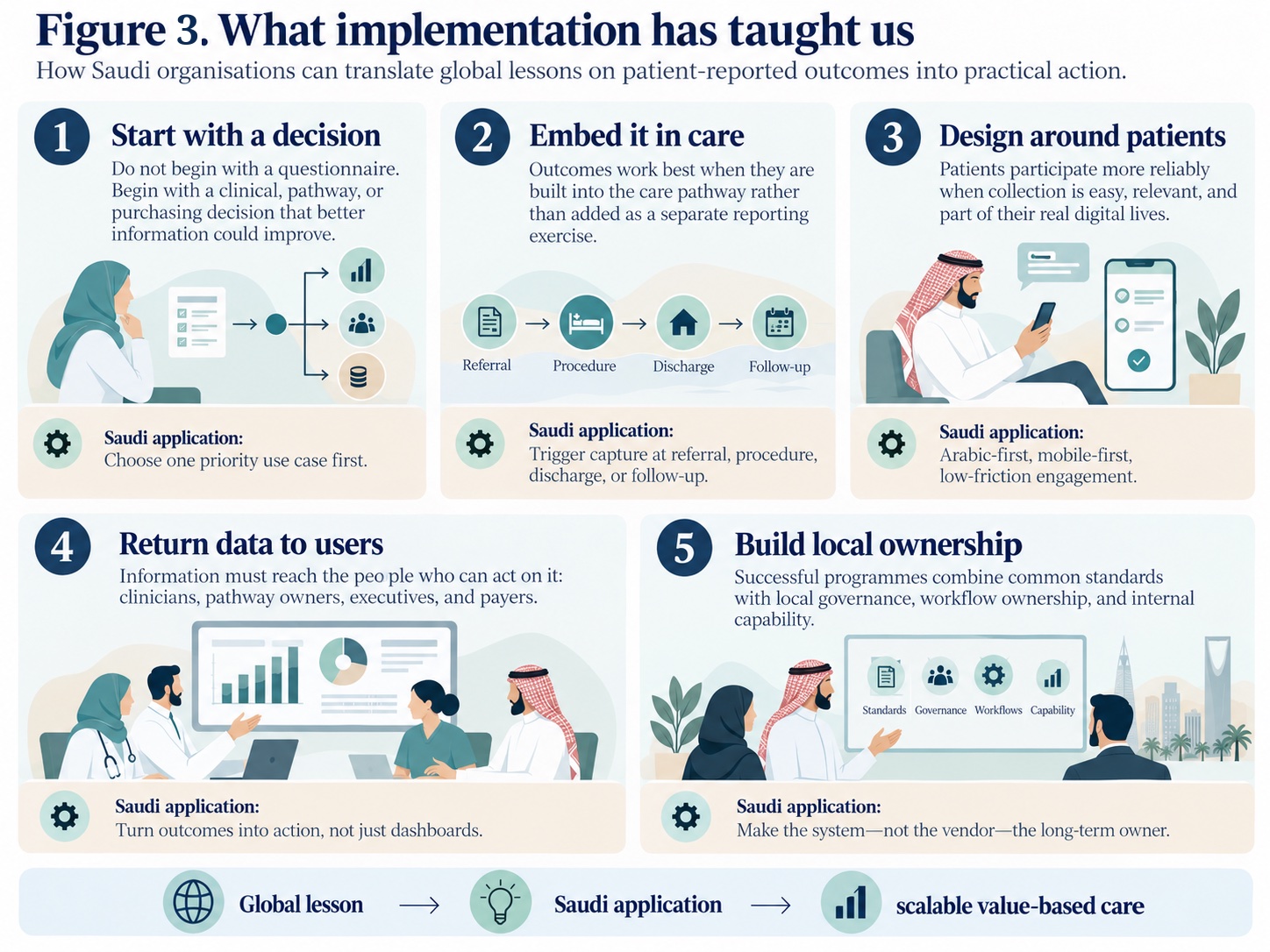
One is that technology should make the pathway simpler, not create a parallel workflow. A patient should not experience outcome measurement as a separate digital programme detached from the care they are receiving. A clinician should not need to open another system simply to discover whether a patient is deteriorating. The information has to appear where decisions already occur.
Another is that a successful programme cannot remain permanently dependent on the technology provider. Clinical teams need to understand and own the pathways. Organisations need governance over their data and clear rules about responsibility. Local capability has to grow as implementation expands. The role of technology is to enable that infrastructure and make it scalable, not to replace institutional ownership.
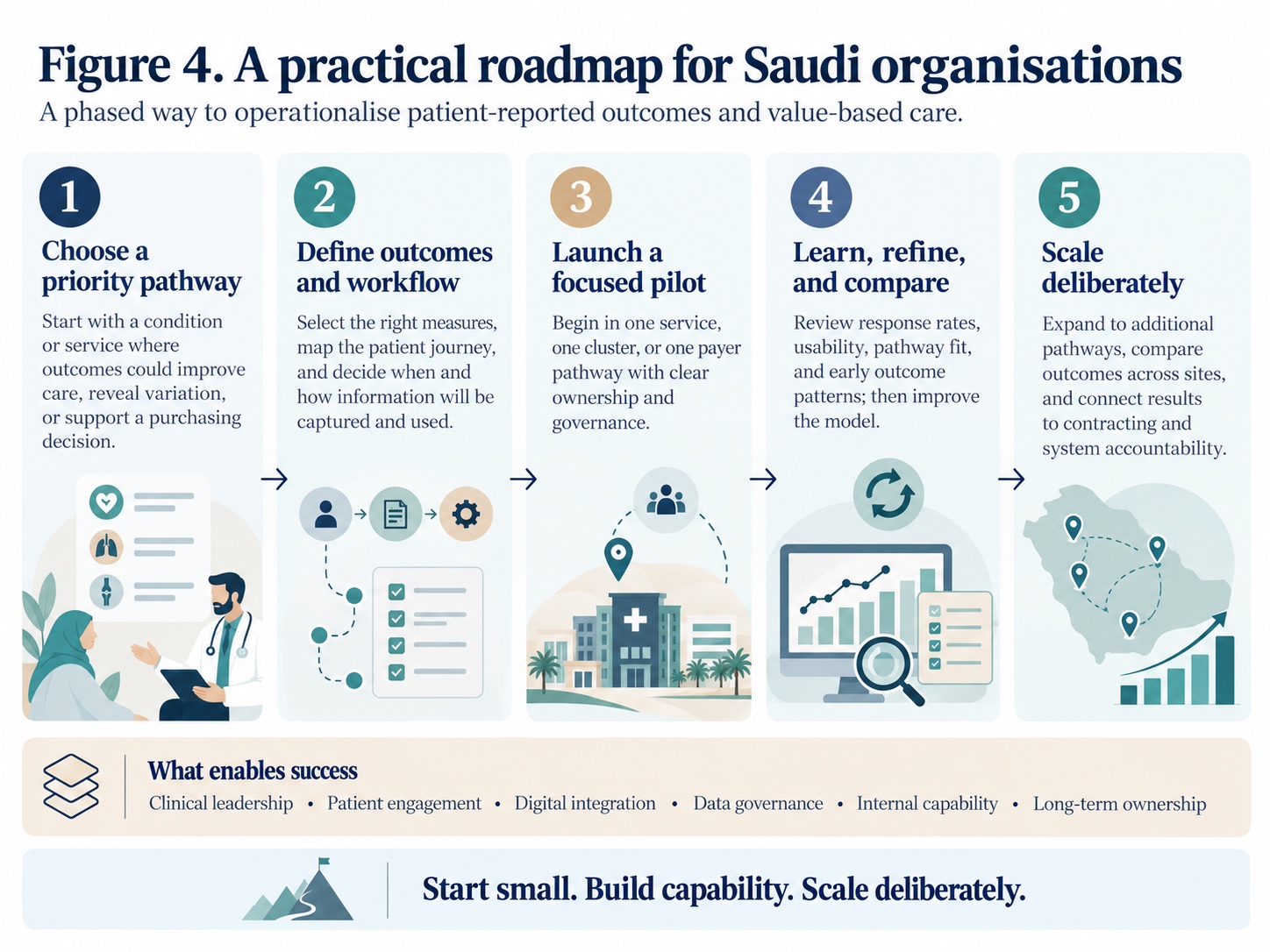
A third lesson is to resist the instinct to begin everywhere at once.
Saudi Arabia does not need every provider measuring every outcome tomorrow. A more practical approach is to start where the clinical or economic question is already clear. A surgical pathway may want to detect recovery problems earlier. A diabetes programme may want to understand quality of life alongside clinical indicators. A cluster may want to compare results across facilities. An insurer may want to test an outcome-linked bundle.
In each case, the measurement has a reason to exist.
The system can then learn from those implementations, standardise what works and scale deliberately.
That is a very different approach from launching a national survey exercise and hoping that useful decisions eventually emerge from the data.
An opportunity to leapfrog
Saudi Arabia has an advantage that many earlier adopters did not. It is building new institutions, digital infrastructure and purchasing arrangements at the same time.
Health systems elsewhere often digitised first, built outcome programmes later and then spent years trying to connect the two. Saudi Arabia has the opportunity to think about those connections earlier.
That does not mean importing another country’s model wholesale. The Saudi health system has its own institutional structures, patient expectations, regulatory environment and patterns of digital use. What can be imported is the learning.
Which implementation approaches fail because they burden clinicians? Which measures generate information but little action? Where is standardisation essential? Where should local clinical teams retain discretion? How should patient information move from the individual encounter to pathway management and eventually to purchasing?
Those are the questions that matter if patient-reported outcomes are to become part of the infrastructure of value-based care rather than another isolated health-technology initiative.
The technology already exists to make much of this possible. Platforms can collect outcomes at scale, automate pathways, support multiple languages, compare results and return information to clinicians and managers. The real challenge is using those capabilities intelligently: deciding where measurement belongs, how it changes decisions and how organisations build enough internal capability to sustain it.
That is where Saudi Arabia’s next phase could become particularly interesting. The Kingdom has already undertaken the far more difficult task of reshaping the structure of its health system. The next step is not simply to collect more information, but to make the results of care increasingly visible and increasingly useful.
Over the coming weeks, we will explore some of these lessons in more practical terms: how patient-reported outcomes can be embedded into clinical pathways; what outcome measurement looks like at cluster scale; how payers can use outcomes in contracting and bundled payment; how technology can support rather than complicate implementation; and what Saudi organisations can learn from programmes that have already attempted this elsewhere.
The purpose is not to present another abstract model of value-based care. It is to translate what has been learned internationally, and increasingly inside the Kingdom, into practical ideas that Saudi providers, payers, and health-system leaders can use.
Saudi Arabia has already changed how healthcare is organised. The opportunity now is to make what that healthcare achieves visible, learn from it, and use it to make the next decision better.